
July 8, 2026
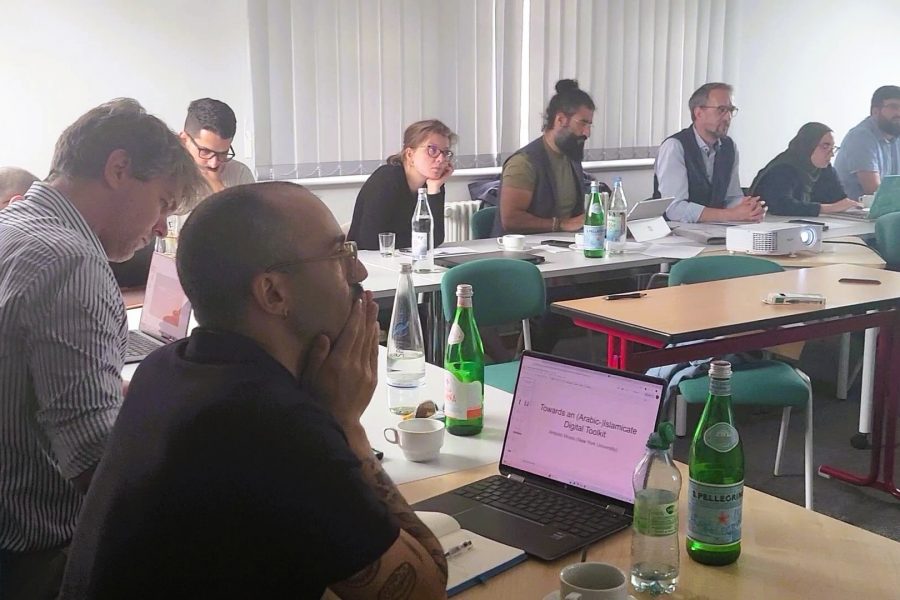
Research Group in Berlin, May 2025
How are the form and content of Muslim self-perception changing in the digital sphere? And how are digital methods being used to study Islamic texts? The research group addressed these and other questions in May 2025 at a meeting held at the Berlin Institute for Islamic Theology at Humboldt University in Berlin.
The first part of the meeting was devoted to an internal exchange on the research work and interim findings of the participating sub-projects. The Frankfurt site, which is investigating historical narratives in Muslim online discourse, contributed three recent studies to the discussion.
An analysis of the Instagram hashtag #ahlulbayt, which refers to the family of the Prophet Muhammad, showed that religious veneration of the Prophet’s family and the commemoration of specific historical events are widespread across all denominations. At the same time, such references often serve as markers of denominational identity. Shi’ite festivals and days of mourning are also of particular significance here, as they are clearly the subject of many posts.
As part of the sub-project on German-Muslim culture of remembrance on social media, the historical figure Malcolm X was identified as one if the most frequently referenced Black Muslim role models on Instagram. In particular, his statements on the equality of believers of different skin colors during the pilgrimage to Mecca are also cited in German-speaking countries to emphasize the universal equality of different ethnic groups within Islam.
A case study of historical narratives put forward by revivalist Sunni actors on Facebook revealed a retrotopia that could be understood in terms of salvation history – that is, the notion of an idealized past to which one should return. The actors analyzed largely adhered to a master narrative of Islamic history characterized by the rapid rise of the early Muslim community, a subsequent golden age and a later decline. The latter has often been interpreted as being closely linked to European colonialism.
The Erfurt sub-project on the aesthetics of audiovisual media presented an analysis of the digital self-representation of official accounts belonging to the Ahmadiyya Muslim Jamaat, as well as accounts belonging to its followers in Germany. The study showed that, visually, both types of account differ only slightly from the visual language of mainstream Islam. Group identity is particularly evident on unofficial accounts, mainly in isolated instances through text and audio clips.
The Berlin sub-project “Prophetic Tradition and Hadith in the Digital Sphere” presented an experimental research design that investigates the use of algorithmic methods to analyze chains of transmission (isnads). The aim is to examine the extent to which digital methods can be used to support research into Hadith studies.
In the second part of the meeting, Dr Joshua Little, currently a research fellow at the University of Groningen, was welcomed as a guest speaker. In his talk, he provided insights into the use of digital tools in Hadith research. The focus was on the commonly used isnad-cum-matn analysis, a method that examines different versions of traditions relating to the Prophet’s sayings and actions whilst simultaneously taking into account their chains of transmission and texts within their respective historical contexts. Dr Little explained which digital tools support this research process and what potential this offers for historical Hadith research.