
July 8, 2026
Online Workshop “Memory in Digital Spaces”
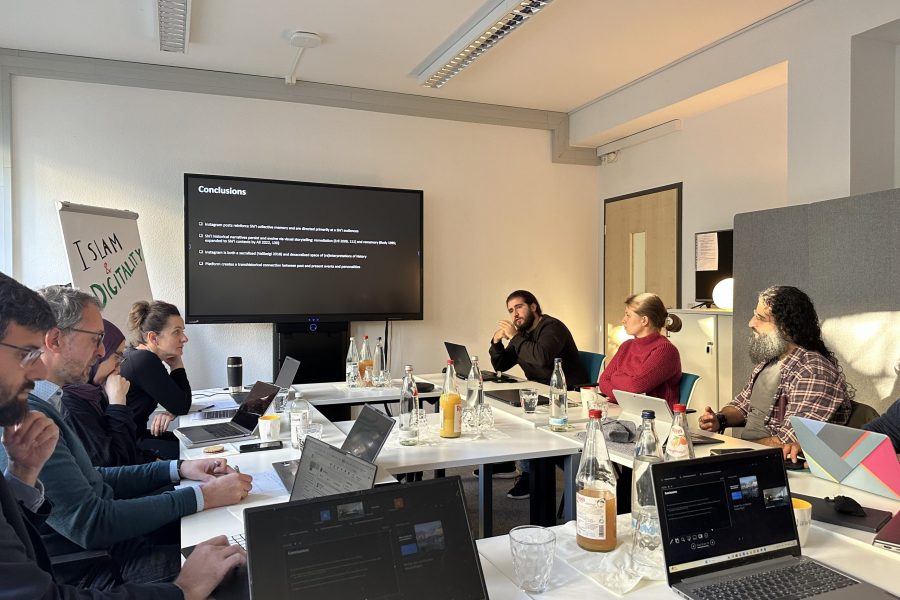
From November 5 to 7, the AIWG research group hosted the online workshop “Memory in Digital Spaces”. The workshop focused on issues related to Muslim cultures of memory in the digital sphere, the significance of historical narratives for the formation of religious identity, and the way such content is represented on social media platforms. At the same time, the workshop provided an opportunity to present the participating scholars’ current research and to engage it with theoretical approaches from the field of memory studies.
Prof. Dr. Armina Omerika delivered the first keynote address. She examined Muslim cultures of remembrance in Germany and argued that collective memory is a central foundation for the formation of Muslim identity. While Muslim history has so far been only marginally visible in mainstream societal discourses, she pointed to the as-yet largely untapped potential of mosque archives as sources of Muslim culture of remembrance.
Dr. Akif Tahiiev (Frankfurt) demonstrated how the traditional visual language of Shi’ite remembrance culture – particularly as it relates to the Twelve Imams – is reimagined on Instagram in various political contexts to place contemporary figures in a historical lineage with historical figures regarded as holy, thereby providing them with religious legitimacy.
Nadeem Elias Khan (Frankfurt) spoke about the use of history in revivalist Sunni nasheed videos on YouTube. Artists from various revivalist Sunni schools of thought draw in particular on the Companions of the Prophet Muhammad as references to aspects of early Islamic history. The differing memories of individual companions, based on religious denomination, are used here to construct a specifically Sunni identity as a distinguishing factor from non-Sunnis, particularly in relation to Shiites.
The portrayal of early Shi’ite history in virtual reality was the topic of the lecture by Dr. Fouad Marei (Frankfurt), a fellow of the AIWG research group. The developers of the app he presented placed great emphasis on historically accurate depictions, although these were nonetheless secondary to religious customs. Users consistently rejected the idea of using their own actions in virtual reality to write an alternative history of the events during the Battle of Karbala (680).
Prof. Dr. Christoph Günther (Erfurt) spoke about a new trend – AI-assisted journeys into the past. AI-generated videos offer viewers audiovisual access to a past imagined by machines and understood as religiously significant. However, in addition to the past, this may also represent the future of the teleological understanding of history in Islam – the afterlife, divided into heaven in hell. What both AI-powered journeys have in common is a visual language strongly influenced by Western culture.
In her presentation, Lale Diklitaş (Frankfurt) examined the discourses on Islamic history among German-speaking Muslim content creators on Instagram. She highlighted how specific events or figures are perceived as particularly worthy of remembrance. Notably, these influencers draw inspiration from other current discourses in global social media culture, both in terms of style and content.
Jasmin Eder (Frankfurt/Erfurt) examined the Ahmadiyya Muslim Jamaat’s social media activities. In doing so, she explored differences in self-identification between members who work professionally on social media and individual influencers from within the community. Like Diklitaş, Eder also identifies borrowings from broader online discourses, specifically meme culture.
In the event’s second keynote address, Prof. Dr. Andrew Hoskins (Edinburgh) addressed the topic of forgetting in the age of digital technology and artificial intelligence. By “digital forgetting,” Hoskins means that the vast amount of data accumulated through digital storage leads to the inaccessibility of that data. This means that evidence—such as that of war crimes—is known in principle but cannot have any real impact. Hoskins believes that this problem is exacerbated by the use of artificial intelligence in the production of digital media, as it is becoming increasingly impossible to verify contemporary sources.
Dr. Ali Aghaei (Berlin) used the work Ṣaḥīfat ar-Riḍā—attributed to the 8th Twelver Shi’ite Imam ʿAlī ar-Riḍā—to demonstrate how artificial intelligence can also reveal the cross-sectarian dissemination of prophetic traditions. It is noteworthy that even traditions whose content serves to foster a sense of identity and which can be clearly attributed to a particular denomination are found in hadith collections of Sunni, Five-Imam Shi’ite, and Twelve-Imam Shi’ite origin.
The presentation by Prof. Dr. Mohammad Gharaibeh (Berlin) focused on apps specifically designed for working with hadiths. Drawing partly on databases and partly on printed works, hadith apps place well-known prophetic traditions—for example, through innovative, topic-specific clustering or application-oriented features, such as the “Hadith of the Day”—into new contexts. Surprisingly, the religious backgrounds of the developers are not disclosed in the examples shown and cannot be determined without significant prior knowledge.